
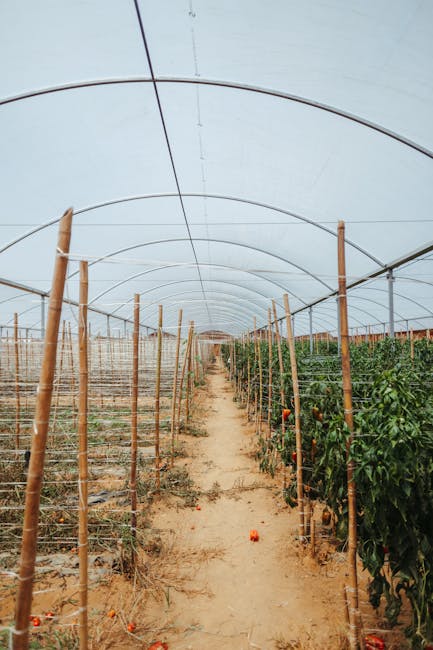
Autonomous Greenhouse Farming: How Canopii Is Reimagining Urban Produce
Autonomous greenhouse farming is moving from concept to commercial reality. Portland-based Canopii has developed robotic greenhouse systems designed to automate the entire crop lifecycle — from seeding to harvest — while dramatically reducing water use, energy demands and logistical complexity. The result: compact farms that can produce tens of thousands of pounds of specialty greens per year in the footprint of a basketball court.
What is autonomous greenhouse farming and how does it work?
At its core, autonomous greenhouse farming combines robotics, sensors, environmental control systems and software orchestration to run crop production with minimal human intervention. Canopii’s approach integrates mechanized planting and harvesting, closed-loop climate control, and precision irrigation to create a continuous, replicable production cycle.
Key technical components
- Robotic seeding and harvesting units that handle delicate specialty greens.
- Environmental sensors and microclimate control for temperature, humidity and light scheduling.
- Precision irrigation systems that deliver only the water plants need.
- Central orchestration software that schedules tasks, diagnoses issues and optimizes yields.
Together these systems enable a farm that runs autonomously: operators set production goals and the system handles the routine operations, freeing human staff to focus on maintenance, quality control and scaling strategy.
Why this matters: shrinking supply chains and boosting freshness
Traditional produce supply chains are long and fragile. Growing specialty greens near consumers shortens delivery timelines, reduces food waste, and improves freshness and flavor. Autonomous greenhouse farms are uniquely positioned to deliver on those benefits because they are:
- Compact — designed to fit small urban lots, rooftops or even backyards.
- Consistent — automation reduces variability in quality and production cycles.
- Local and scalable — replicable units can be deployed regionally, lowering transportation emissions and logistical complexity.
Canopii claims that its units can produce up to 40,000 pounds of herbs and specialty greens annually, all within a footprint comparable to a basketball court. That yields a high output-per-square-foot ratio that makes local sourcing financially and operationally viable for restaurants, schools and urban food hubs.
How resource-efficient are robotic greenhouses?
Resource management is central to the autonomous greenhouse thesis. Canopii highlights two striking efficiency metrics:
- Extremely low water use — the system is engineered to run on a single spigot, with closed-loop irrigation minimizing waste.
- Household-level power requirements — the farm operates on a standard 240V, 100-amp circuit in many deployments, meaning it can run on conventional electrical infrastructure rather than custom industrial power hookups.
These efficiencies lower the barriers to deployment: sites that lack heavy infrastructure can still host productive farms. For enterprises and municipalities, the promise is cheaper siting and faster rollout compared with larger vertical-farming facilities that require specialized power and water installations.
Who is behind the startup?
Canopii was founded by David Ashton, who drew inspiration from observing large-scale produce grown in drought-impacted regions and shipped long distances. That disparity — lush crops in dry landscapes destined for distant markets — motivated a design philosophy focused on local, resource-frugal production.
Canopii’s units are manufactured by GK Designs and are optimized for herbs and specialty greens such as baby bok choy and gai lan (Chinese broccoli). The team iterated on prototypes and pursued competitive grant funding to accelerate development, validating the technology on a working farm before moving toward commercial deployments.
Funding strategy and measured growth
Rather than scaling purely through venture capital, Canopii pursued a diversified capital stack that included grants and strategic investments. This deliberate, measured approach meant the company could iterate on a single working farm for several years, learning operational lessons that many fast-scaling competitors missed.
That cautious scaling approach has several advantages:
- It reduces the risk of overbuilding unvalidated infrastructure.
- It ensures that product improvements are grounded in operational realities.
- It enables modular, manufacturable designs ready for replication when market fit is proven.
Canopii has reported a mix of grant funding and strategic capital to bring its autonomous greenhouse from prototype to commercially viable product.
How is the market responding?
Interest has come from a diverse set of customers: restaurants seeking hyper-local greens, educational institutions looking for on-site food programs, and hospitality venues exploring consistent, high-quality produce for large-scale operations. With the automation milestone achieved, Canopii is planning its first commercial deployment in downtown Portland and evaluating franchise and licensing models for wider distribution.
Potential use cases
- Urban restaurants and chefs wanting continuous supply of specialty greens.
- School food programs prioritizing freshness and educational value.
- Food halls, casinos, and hospitality businesses aiming to highlight locally grown produce.
What challenges remain for autonomous greenhouse startups?
Despite the promise, several challenges typical to indoor and automated agriculture persist:
- Market education — convincing buyers that automated, local produce can match or exceed quality of traditional supply chains.
- Operational scale-up — moving from one validated unit to production at scale requires manufacturing, service networks and reliable supply chains for inputs.
- Capital allocation — balancing grant-funded R&D with commercial investment to expand sales and installation teams.
By focusing on iterative learning and measured growth, Canopii aims to mitigate these risks and establish repeatable deployment playbooks before raising larger rounds of venture capital.
How do autonomous farms tie into broader sustainability and infrastructure trends?
Resource-efficient micro-farms intersect with wider conversations about energy and infrastructure for tech-driven systems. For organizations planning to deploy distributed farms, thinking about energy consumption and infrastructure resilience is essential. For background on how energy and infrastructure pressures shape tech deployments, see our analysis of AI energy trends and infrastructure investments: AI Energy Consumption: Myths, Facts & Solutions 2026 and AI Memory Orchestration: Cutting Costs in AI Infrastructure.
Can autonomous greenhouse farming be replicated at scale?
Replication depends on a few factors:
- Manufacturability: systems need to be mass-producible with consistent quality.
- Serviceability: local technicians and predictable maintenance routines must be in place.
- Market access: restaurants, institutions and retailers must be open to new sourcing models.
Canopii’s roadmap includes franchising or licensing a manufacturable unit that can be assembled and installed quickly, analogous to how certain consumer products scale through standardized production and distribution channels. The startup’s claim that a unit operates on standard residential power underscores the intent to lower installation friction for urban deployments.
What are the broader implications for food systems?
Autonomous greenhouse farming can contribute to decentralizing food production, shortening supply chains, and expanding access to fresh produce in urban centers. That shift could reduce transport emissions, lower spoilage, and create new local jobs in installation, operations and distribution. However, realizing those benefits requires coordinated investments in manufacturing, deployment logistics and customer education.
Potential societal benefits
- Improved food security through distributed production.
- Lower environmental footprint for specialty produce due to reduced transport.
- New educational and workforce development opportunities centered on modern agtech.
How does Canopii differentiate from vertical farms?
Although often compared to vertical farms, autonomous greenhouse systems differ in several ways. Canopii emphasizes a design that prioritizes compact footprint, low electrical draw and resource optimization rather than multi-story racks that demand heavy power and bespoke facility infrastructure. This enables different siting options — urban rooftops, backyards, or underutilized commercial lots — and can reduce upfront capital expenditures.
Next steps: commercialization and partnership strategy
With autonomous operation validated on a working farm, Canopii is moving toward commercial rollouts. The company’s near-term priorities include:
- Building its first downtown commercial farm to demonstrate the model at scale.
- Establishing manufacturing and service partnerships for repeatable deployments.
- Exploring franchise or licensing models to accelerate regional expansion.
These steps will determine whether the technology scales affordably while preserving the operational lessons learned during the prototype phase.
Frequently asked question: Is autonomous greenhouse farming the future of urban produce?
Short answer: it can be one important part of the future food ecosystem. Autonomous greenhouse farms offer a compelling combination of local production, resource efficiency and predictable output — qualities that align with urban demand for fresh, reliable produce. However, they are one tool among many, and their success depends on cost-competitive manufacturing, supportive policy, and buyer adoption.
Conclusion and call to action
Canopii’s autonomous greenhouse farming represents a practical, resource-conscious approach to growing specialty greens close to where people live and eat. By automating the tedious parts of crop production and optimizing for low water and power usage, these systems lower the barriers to local production. As deployments move from prototype to commercial sites, the model will be tested across diverse real-world conditions — and that testing will reveal where autonomous farms deliver the most value.
If you’re a restaurateur, school administrator, or facilities manager curious about hosting an autonomous greenhouse or partnering on a pilot, we want to hear from you. Explore partnership opportunities with Canopii and learn how to bring local, automated produce to your community.
Ready to pilot an autonomous farm? Contact us to schedule a demo or to discuss franchise and partnership options. Start the conversation to bring fresh, efficient, local produce to your site.